
Tuesday, November 25, 2025
Sylow Workspaces

Sylow is extremely proud to announce beta testing for our new application, Workspaces!
I'll spare you the sales pitch—this post exists to explain what it is, why we built it, and why we think it's worth your time.
AI is helpful. We want it to be useful.
Large language models have undoubtedly become very helpful tools. They can summarize your meetings, polish your emails, plan your calendars, etc. And while that helpfulness can make an impact when scaled to every employee, it's generally not moving organizations forward in strategic ways.
Recent research about "workslop" actually shows marked decreases in productivity. The trend of taking a spreadsheet, not looking at it, throwing it into ChatGPT, and sending it to someone else to look over has just created more work for managers and reviewers.
So, how do we make AI actually useful?
Workspaces was built to solve this. We think it comes down to three things: connection, collaboration, and context.
Connection
Real insights don’t live in Google Drive. Or your ERP. Or whatever app is meant to be the “ground truth” of your company. It lives everywhere—across every app, database, message, and water-cooler conversation.
The current paradigm of "connect a single app, have a model talk to it, spit out a report" is just not how real work gets done, and not how real decisions get made.
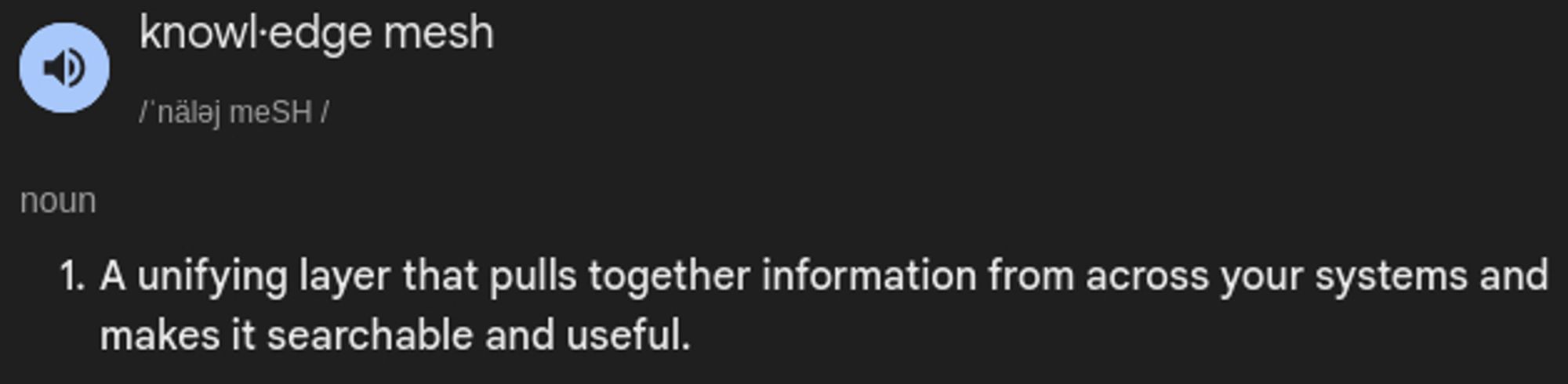
Workspaces is built to handle complex, multi-application search that synthesizes into actionable insights. We call this a "Knowledge Mesh"—a unifying layer that pulls information from across your tech stack to make it searchable and, more importantly, useful.
This will be a topic for future blog posts, but the engineering behind taking legacy software and transforming it into AI-consumable tools/data sources has been a key part of how Sylow engineers have built this app.
Collaboration
We also know that real work happens in teams. We strongly believe that the model should be part of that, not a cheat-sheet on the side.
Workspaces is designed to enable teams to work together in a single spot, building shared context for exactly what they need. When everyone chats in a workspace, adds files, and connects applications, the model becomes enriched with that collective intelligence.
This means no more time spent catching the model up to speed every time you have a question. Workspaces are designed to be in-the-loop.
Context
That leads into one of our core tenets here at Sylow: context is everything.
Think of context as what the model has access to before generating a single response—the prompt, your files, its memories, your connected applications. The richer the context, the better the output.
Workspaces are designed to reflect how teams actually work and grow smarter over time. As your team collaborates, the workspace builds institutional knowledge. Every conversation, every file, every connected data source makes the model more capable of giving you a correct, highly-contextualized answer.
How should I build a Workspace?
That's up to how your team functions.
A single workspace for your sales team might be connected to Slack, HubSpot, Salesforce, Odoo, etc., and contain all your documents about deal history, company practices, templates, and more.
That kind of workspace would be great for general context around your team and onboarding new employees. Got a question? Go to the sales workspace and just ask.
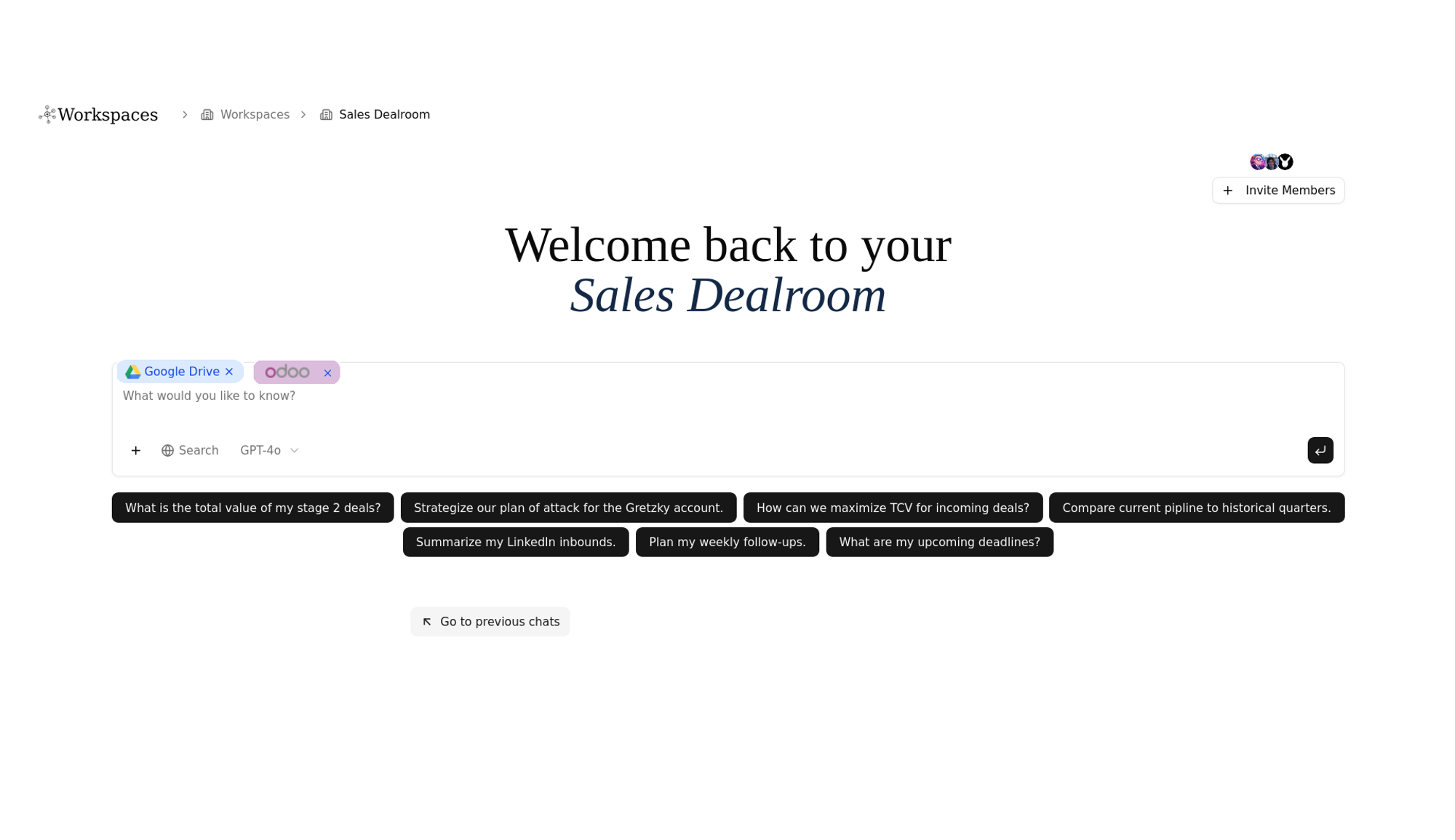
If your sales team has structured ways of going about deals, then it might make sense to build a workspace for every deal. Add your sales reps, your sales engineers, whoever is involved, and throw everything in there.
Use it to plan follow-ups, next steps, and strategy. The model is meant to become an expert at that workspace—a new source of ground truth for everything related to its intent.
That's one of the things we find most compelling about Workspaces. Real work doesn't fall neatly into labeled folders. These things are fluid, and it's not always intuitive how to best organize them.
Your "ABC Corp" deal lives scattered across Slack threads, email chains, Salesforce notes, shared drives, and someone's local notes from a call. Workspaces let you pull all of those disparate pieces together in one place—not because they share a file type or live in the same app, but because they're all part of the same thing you're trying to accomplish.
The workspace becomes the single source of truth for that deal, that project, that initiative—organized around the work itself, not around where the files happen to live.
How we measure success
For all that opining about what we see as “useful”, I think it's important to show how we actually measure that. For any given workspace, we want to see something like this:

Yes, we want to see chat length go down.
Now, you might ask yourself, why would an AI company want that? Because, generally, it means you got the right answer the first time you asked. That's the goal.
Cut through not just the overwhelming amount of data at your disposal, but through the boundless ways you can misinterpret it.
The right answer, the first time.
It's important to note that we do not want to see the number of net-new chats decrease—that would just mean the workspace is stale. We ideally want a ton of chats with only 1 or 2 messages.
How can I try it?
Sign up for our waitlist here!
The product is still in heavy testing, but best believe that we are moving very fast.
If you made it this far, I sincerely thank you for your time, and hope you take a look!
Ethan Henley
Co-Founder & CEO